

When Spies Pick Sides, Which Team Do You Want To Play For? "PONIES" Power Players Stop By To Drop Some 411!
Artjom Gilz and Petro Ninovskyi slip by to talk espionage, power dynamics, and more.

Enter Russia, the year is 1977 and the disco ball isn’t the only thing going around creating an illusion. Peacocks thrilling hit spy centric dramedy PONIES is streaming now. In PONIES, fear doesn’t announce itself in the way we are accustomed. It settles into rooms like a secret agent in the night—disguising itself as procedure, obedience, and patriotism. By the time it reveals its teeth, the damage has already been done.


That tension—palpable, electric, and corrosive—bleed into the performances of antagonist Andrei (Artjom Gilz) and protagonist Sasha (Petro Ninovskyi). On paper, one appears to be the threat and the other a liability as they both become romantically entangled with lead character Bea (Emilia Clarke). On screen, PONIES is far more interested in what happens when those labels are reshaped under pressure and what each person is willingly to risk both physically and emotionally when faced with the truth and dark secrets are revealed.
Speaking with our Senior Editor Kivonshe, Artjom Gilz and Petro Ninovskyi stopped by to give the 411 on their characters plus tell us more about the elusive nature and dangerous situations involved with being a spy or undercover agent.


Andrei, a high level KGB agent is introduced as a presence meant to be feared. He moves with certainty, speaks with authority, and operates as though the machinery of the KGB bends to his will. Cold, deadly, and dare we say ambitious. Andrei embodies the all of the things that the Russians want someone to fear from the KGB.
However, Gilz is careful not to frame Andrei as the apex predator. Instead, he describes him as a man trapped inside a hierarchy, someone whose authority is constantly negotiated rather than absolute. The revelation that Andrei answers to forces beyond himself doesn’t weaken the character—it emboldens him. His menacing nature comes not from freedom, but from constraint. This revelation adds an alternately complex layer to Andrei— silently ushering in thoughts for viewers about what life looks from his point of view. In a way having, having audiences slightly wonder if Andrei’s prowess and madness more circumspect than we’ve been shown?
In our chat, Gilz said, “I think it’s great that the characters are like, so multi dimensional and you don’t expect a villain that you get in the beginning— and then you kind of slowly see it unfold. Like, what he really is like and like what his struggles are, and that he’s really just mean KGB. That he really struggles for power or that he has his obstacles. When really the way he treats people is like he’s been he’s being treated, you know? So I think that was very important that we do get to see that. and having Nikita on the other side playing Yuri. I mean, that guy is phenomenally talented. He just came in with such a presence, with such a force—that it wasn’t hard to kind of go, Okay…you’re the boss!”
Andrei’s power is conditional. His violence is procedural. His morality…negotiable. In this way, PONIES resists the simplicity of villainy. It asks a harder question: what happens when the person you fear is just as cornered as everyone else?
If Andrei survives through measured control, Sasha survives through chaotic near exposure. Sasha enters the story as a man vibrating with fear—his body language tight, his decisions reactive, his loyalty fractured by grief. Leaning into that instability, Sasha’s anxiety becomes one of the most honest and organic things about him. As Sasha, Petro Ninovskyi gave a believable performance that captures Sasha’s nervous nature with ease. His portrayal is both natural and authentic—creating a heighted sense of alert with audiences—serving as a reminder that one wrong statement, one read of his body language, or one false use of dialogue can instantly lead to a life or death situation.
Scenes In Color asked Ninovskyi, How did you build that anxiety and that anxiousness in Sasha? Like, are you this anxious in real life?
Ninovskyi stated: Yes, super anxious. Honestly, I think this anxiety is a part of me, as well as a part of Sasha. But maybe Sasha’s is pretty extreme. I think it was very easy for me, as soon as I read that line of one of the character. Is he always like that? And the other character asked, like what? Like, he’s having a heart attack (laughs).
He goes on state, “There’s something there I need to play with, I need to play and I think that just like the world that he lived in was constantly very, very anxiety mongering for him—I would say it’s the world where you had to look back every time and see whether somebody’s following you or not. So that that propelled the anxiety in my character. “
Rather than playing Sasha as naive or quietly cunning, Ninovskyi carried him as a man desperate for clarity. In many ways Sasha is similar to Bea, a novice to this lifestyle— playing a role that far exceeds their knowledge of secret government agency workings, physical safety level, and personal moral capacity. Both are also willing to put themselves in harms way to contribute to the cause in hopes that it leads them to the answers they seek.
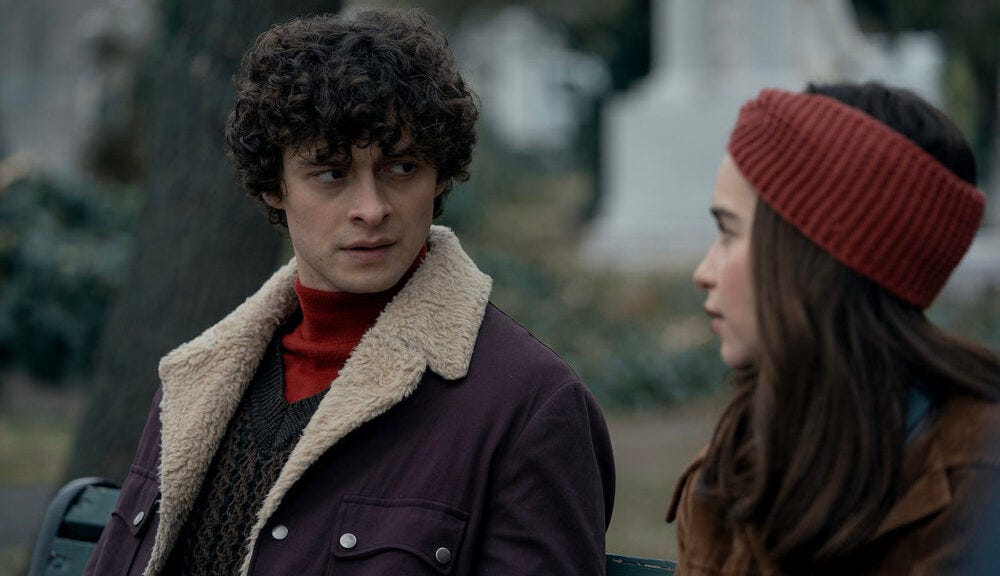
Sasha’s alliance with American intelligence isn’t ideological—it’s personal. He wants answers. He wants accountability. And most of all, he wants the truth about his sister’s death to mean something. But for Sasha, sincerity is dangerous. Sasha’s vulnerability doesn’t protect him, it exposes him. And yet, it is the one strength that keeps him rooted in innocence, despite his grave surroundings and dealings with unsavory associates.
The connection between Sasha and Andrei feels more like a collision that is impossible to avoid. Their interactions go from coincidence to chaos, spurred by Bea’s undercover operations and the closing gap in CIA and KGB actions that eventually merge their lives together completely.
What’s striking is how neither character ever fully owns the narrative they’re trapped inside. Each believes they’re acting with intention, yet both are constantly reacting to decisions made elsewhere—by institutions, by history, by lovers, or by power structures that view them as expendable. Even if they do hold some of the cards, the outcome of the game will be decided by circumstances beyond their grasp. That inevitability is where PONIES finds its emotional gravity with these two characters. These men are not foils. Though operating on different levels, they are reflections of their environment except with different responses to the same political regime and power players.
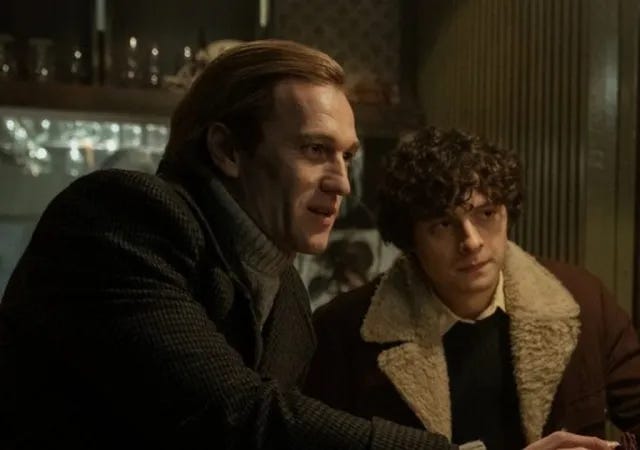
However, one of the series’ quiet achievements is its commitment to linguistic authenticity. Russian isn’t ornamental here; it’s operational and serves as a reminder to these characters that Russia is the turf that the game is being played on. It becomes a tool of exclusion and control, a way to shift power in scenes without altering the plot, often reminding lead characters Bea and Twila (Haley Lu Richardson) that they are out of their league—regardless of how convincing and easily intelligible Bea’s Russian dialogue comes across.
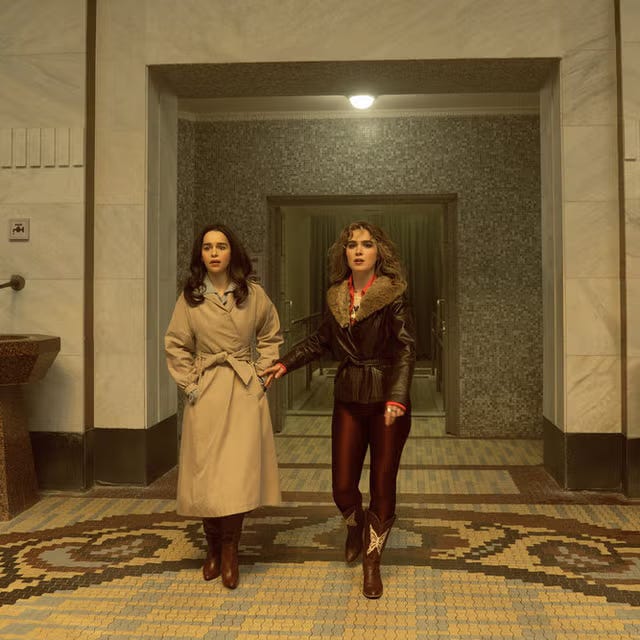
By the finale, the ground has shifted beneath both characters, literally. Loyalties are exposed. Structures collapse. Survival becomes less about ideology and more about calculated instinct. Andrei walks free—but freedom is a complicated construct. That ambiguity feels intentional and PONIES proves it is not interested in clean endings. Therefore, the fate of Andrei seems wide open while the Sasha’s fate hangs by a thread— expounding the balance between freedom and death. These fates can either expand their storylines further or end them— sealing the fate for these well portrayed and authentic characters.
PONIES is now streaming on Peacock.